Not A Subscriber?
Join 752+ language learners getting mindf*cked every Saturday morning while getting Immersed.
Why Your Brain Gave Korean A Storage Closet (And How To Change That)
December 14th, 2025 | Ademola Adeyemi
Close your eyes and imagine your brain as Pixar showed us in Inside Out:

A vast control center with thousands of workers bustling about, managing emotions, memories, skills, and systems.
There’s a headquarters where the main action happens.
But below it?
Massive warehouses full of memory spheres, automated systems running constantly, and specialized teams working 24/7 on different projects.
The Language Department
Now imagine there’s a Language Department.
It’s huge.
The English section is a sprawling, state-of-the-art facility that’s been under construction and refinement for your entire life.
It’s got:
- Multiple wings
- Automated processes
- Sophisticated categorization systems
- Rapid-retrieval mechanisms
- Workers who know every inch of the operation
They can pull up any word, any grammar pattern, any idiom in milliseconds.
They’ve been perfecting this system for decades.
The Korean Request
One day, a message comes from Headquarters (your conscious mind):
“We’re starting a new language. Korean.”
The workers look at each other.
They pull out the plans.
Korean gets… a storage closet in the basement.
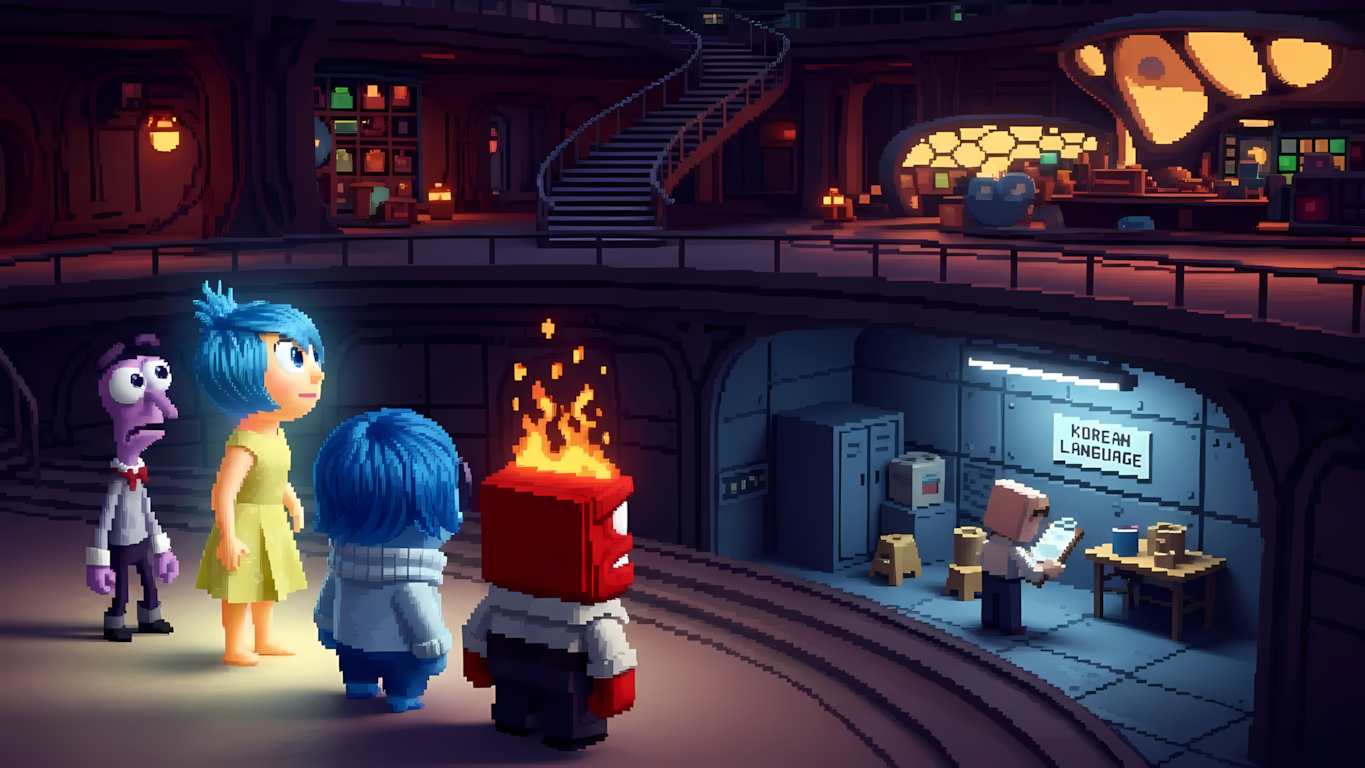
Maybe a desk.
One worker assigned part-time.
“That’s it?” you might ask.
“Well, yeah,” the foreman says, reading from a clipboard.
“According to our records, this is the 21st time Headquarters has announced we’re learning a new language.”
We started:
- Japanese in 2015 — abandoned after three weeks
- Then Mandarin — one month
- Then back to Japanese — two weeks
- French — one week
- Spanish — three days
- German — watched two YouTube videos
- Italian — downloaded Duolingo, never opened it
The foreman flips through pages of the clipboard.
Sure enough, there’s a tally board on the wall.
Twenty-one hash marks under “Times We’ve Started a New Language Project.”
And right next to it, another tally board:
“Times We’ve Followed Through.”
That one’s blank.
Why Your Brain Is Being Logical
“So yeah,” the foreman continues, “Korean gets a storage closet until you prove this is serious. We’re not wasting resources on another abandoned project.”
This is your subconscious mind’s logical response to your conscious mind’s enthusiasm.
Your subconscious workers aren’t being mean or sabotaging your language learning.
They’re being efficient.
They’ve learned from experience.
Why dedicate massive resources to a project that historically gets abandoned?
But here’s where it gets interesting:
If you actually show up — if you actually do the work, day after day, week after week — those workers start to notice.
The Progression of Proof
First day: “Huh. He’s actually studying. Okay.”
Third day: “Still here. Interesting.”
First week: “Alright, maybe we should send a second worker.”
Second week: “He’s serious about this. Let’s upgrade from storage closet to actual office space.”
First month: “Okay, this might be real. Let’s assign a proper team.”
Third month: “This is happening. Let’s start building a real facility.”
And gradually, those workers start building.
They’re constructing the Korean language system in your brain.
They’re creating:
- Filing systems for vocabulary
- Automated processes for common grammar patterns
- Rapid-retrieval mechanisms for high-frequency phrases
- Round-the-clock systems that improve while you sleep
They’re working around the clock, and they’re good at their job.
But—and this is critical—they can only build with the materials you give them.
Active Study: Delivering Raw Materials
When you actively study Korean, you’re delivering raw materials to the construction site.
Vocabulary lists are like truckloads of bricks.
Grammar explanations are like blueprints.
Example sentences are like seeing how other buildings were constructed.
You’re providing resources, but the workers have to actually build the structure.
Passive Listening: Letting The Workers Work
When you passively listen to Korean, you’re letting the workers do their job without micromanaging.
You’re not standing over their shoulders saying:
- “Wait, explain that grammar point again”
- “Hold on, let me look up that word”
- “Stop, I need to understand this perfectly before we move on”
You’re letting them work at their own pace, in their own way, using their own expertise.
And here’s the thing about these workers:
They’re incredible at pattern recognition.
That’s literally their job.
They’ve been doing it since you were born.
They built your entire English language system without you consciously directing them.
They can do the same with Korean if you let them.
But you have to stop micromanaging.
The Micromanagement Problem
Imagine you’re at the construction site, and every time a worker picks up a brick, you stop them:
“Wait, what kind of brick is that? Where did it come from? Why are you putting it there? Let me check my manual. Let me verify this is correct. Hold on, I need to look this up. Actually, maybe we should use a different brick. I’m not sure about this one.”
The worker stands there, brick in hand, waiting for you to finish.
Meanwhile, the entire construction process grinds to a halt.
This is what happens when you try to consciously process everything in language learning.
You’re micromanaging workers who know their job better than you do.
Trust Your Subconscious Workers
“But I’m not good at this,” you protest. “I make mistakes. I don’t understand. I need to consciously check everything.”
No.
You’re not good at consciously processing language.
But your subconscious workers?
They’re phenomenal at it.
They:
- Built your entire English system
- Can recognize patterns you can’t consciously see
- Can extract meaning from context you can’t consciously process
- Can automate processes you couldn’t manually perform if you tried
But they need three things:
The 3 Requirements For Your Workers
1. Raw materials (input)

You have to give them vocabulary, grammar patterns, example sentences.
You can’t build a house without bricks.
Active study provides these materials.
2. Time and space to work (passive exposure)

Let them take those raw materials and actually build something.
Passive listening is you stepping back and letting the workers do their job without interruption.
3. Rest periods (sleep)

Even the best construction crew needs breaks.
Sleep is when the biggest building happens.
Björn Rasch’s research shows that sleep not only consolidates memories but actively strengthens weak ones.
During sleep, your workers are:
- Reviewing the day’s materials
- Sorting them
- Filing them
- Integrating them into the existing system
The Morale Problem: Negative Self-Talk
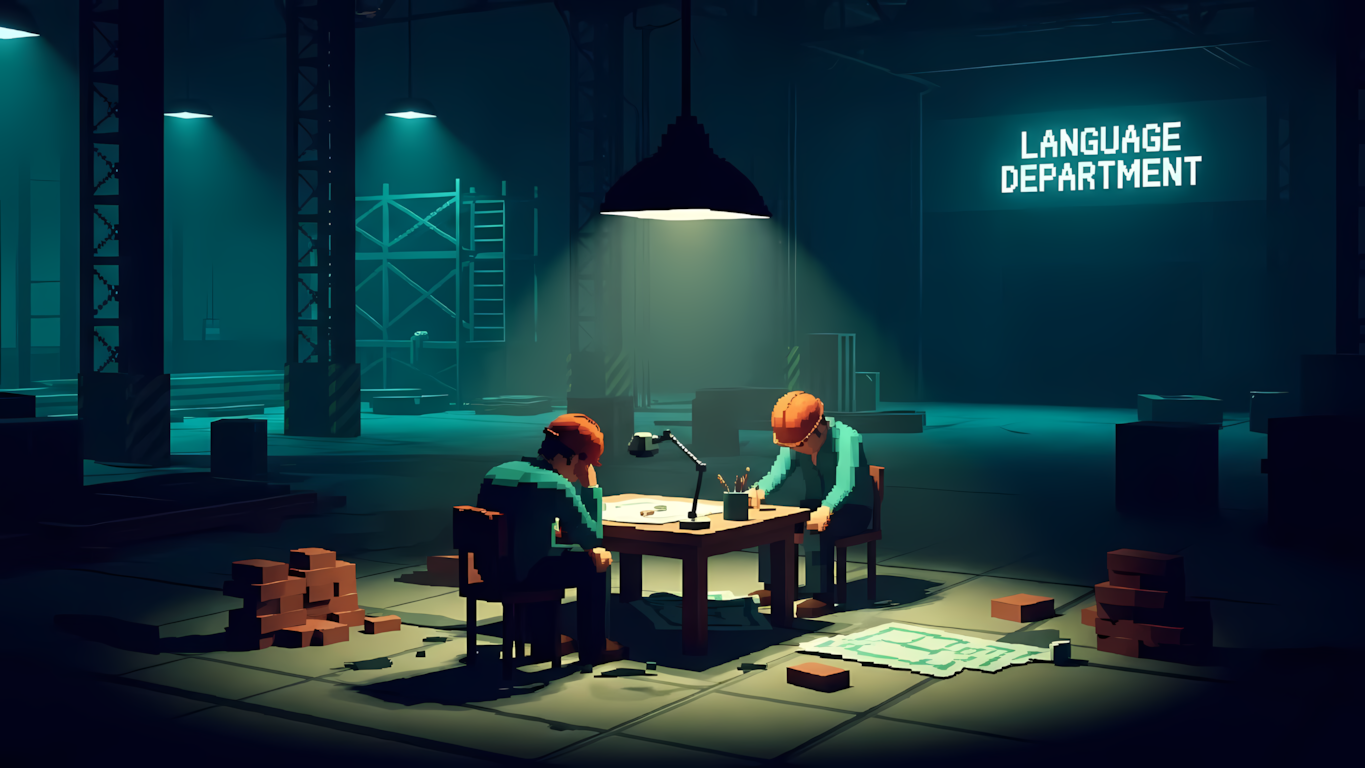
Now, here’s where people really mess up: they start berating the workers.
“Why can’t I understand this? What’s wrong with me? Why won’t this sentence stick? I’m so stupid. I should be better at this by now. Why is this so hard? Everyone else can do this. I must be broken.”
Down in the language department, the workers hear this.
Morale tanks.
“We’re trying our best here,” one worker says. “The system is running at capacity. We’ve been working around the clock. We’re making progress—look at all we’ve built in just three months! But he keeps saying we’re failing.”
Another worker slumps in their chair. “Maybe we’re not good enough. Maybe this is too hard. Maybe we should just give up.”
Negative self-talk doesn’t just make you feel bad.
It actually impedes the construction process.
Your workers:
- Lose confidence
- Start second-guessing their decisions
- Slow down
- Become tentative
The vibrant construction site becomes a demoralized workplace where no one wants to be.
The Power of Positive Self-Talk

Compare this to positive, patient self-talk:
“I’m learning. This is hard, but I’m making progress. Look at what I couldn’t do three months ago that I can do now. The workers are doing an amazing job. I’m going to keep providing materials and let them build.”
Down in the language department, morale soars.
Workers high-five.
Someone brings donuts.
They’re energized, motivated, working efficiently.
The construction speeds up.
The Korean facility starts taking shape, and it’s beautiful.
What Your Workers Need From You
Your subconscious workers want to succeed.
They want to build you an incredible Korean language system.
They’re skilled, dedicated, and working around the clock.
But they need you to:
- Show up consistently (so they know this project is real)
- Provide raw materials (active study)
- Get out of their way (passive listening, trust the process)
- Let them rest (sleep)
- Stop micromanaging (trust their expertise)
- Stop berating them (positive self-talk)
- Celebrate progress (acknowledge what they’ve built)
The Transformation
Do this, and one day you’ll wake up and realize:
The Korean facility in your brain is massive.
It’s sophisticated.
It’s automated.
And those workers?
They’re proud of what they built.
They’re ready for the next project.
Because they know now that when you start something, you finish it.
The tally board on the wall?
Under “Times We’ve Followed Through,” there’s finally a hash mark.
And your workers are ready to add more.


Struggle Less. Acquire More. Enjoy Life.
Studied at Yonsei University. Worked in Korean politics. Reached fluency in 18 months through pure immersion.
Now I help language learners cut through the noise and achieve what most think is impossible.
Gain A New Perspective On Language & Life
I went from understanding 0% of Korean dramas to discussing politics at Yonsei in 25 months—using the same immersion principles I teach every Saturday.