Not A Subscriber?
Join 917+ language learners getting mindf*cked every Saturday morning while getting Immersed.
Perfect Speaking vs Perfect Understanding
March 14th, 2026 | Ademola Adeyemi

Here’s a hypothetical that should take you three seconds to answer.
You’re learning a language. A genie shows up. He offers you one of two gifts:
Option A: Perfect speaking. Native accent. Any dialect. Zero hesitation. Every word exits your mouth exactly the way you intend it.
Option B: Perfect understanding. Every sound that enters your ears resolves into meaning. Instantly. Completely. Every joke, every subtext, every mumbled side comment, you catch it all.
Pick one.
Simple, right? Two options. Pick the one you want more. Move on with your life.
I have been stuck on this question for weeks. Not because I don’t have an opinion, I do. But because every time I tried to argue one side, the other side said something I couldn’t refute. And every time I tried to define what “perfect speaking” and “perfect understanding” actually mean, the definitions collapsed on themselves like a house of cards in a hurricane.
What started as a fun thought experiment turned into the most frustrating intellectual exercise I’ve put myself through this year. And I think the reason it broke me is also the reason it might be worth reading.
Let me show you what happened.

[SPEAKER]: Bro. Speaking. Obviously.
You know what everyone’s deepest pain in language learning is?
Five words: “I understand, but I can’t speak.”
Every bilingual kid who grew up hearing their parents’ language but responding in English knows this ache. You’re technically one of your people. But you’ve never felt like one of your people, because the words won’t come out the right way. Or at all.
So the genie shows up and says “I’ll give you perfect speaking”, native accent, any dialect, flawless delivery, and you’re going to say no? You’re going to choose to be the bilingual kid forever? The person who understands everything but sits there in silence at the family dinner while everyone else is laughing and telling stories?
Nah. Give me perfect speaking. I will never be the person who stumbles over a sentence. I will never watch someone’s face shift from patience to pity while I search for the right word. I will never get the “wow, how long have you been learning?” followed by that polite smile that tells you it wasn’t a compliment.
That fear, the fear of opening your mouth and revealing you don’t belong, gone. Overnight.
Plus, here’s the thing nobody talks about: learning to understand is the solo sport. Watch shows. Listen to podcasts. Read books. It’s all there, infinitely available, no appointment needed. But speaking? Speaking requires another human being. Speaking is the muscle that atrophies the moment you stop exercising it. If the genie is offering to permanently max out the skill that’s hardest to build alone, you take that deal every single time.

[UNDERSTANDER]: You done?
[SPEAKER]: I’m done.
[UNDERSTANDER]: Cool. Quick question. You speak perfectly. Someone responds to you. Do you understand them?
[SPEAKER]: …
[UNDERSTANDER]: That’s what I thought.
[UNDERSTANDER]: Let me paint you a picture.
You walk into a room in Seoul. Perfect Busan dialect. Everyone’s eyes go wide, damn, where’d this guy learn to talk like that? You’re cracking jokes. You’re flowing. You’re the life of the room.
Then someone asks you a question. A normal, everyday question. And your face does that thing, that little freeze where your eyes go slightly vacant because you’re processing and nothing is landing.
The room notices.

Connections start warm and die cold. That’s what happens to a person who speaks perfectly but can’t understand what comes back at them. The first impression is incredible. The second impression is confusion. And by the third interaction, people are speaking slower for you, simplifying their sentences, switching to English out of convenience, and you’re right back to being the foreigner. Except now it’s worse, because you sounded like you belonged.
[SPEAKER]: Okay, dramatic. But I said my understanding isn’t zero, it’s wherever it is right now. I can build from there. And everything I say, I understand. So my own output becomes my input. I’m building a bridge.

[UNDERSTANDER]: A bridge from where to where? You’re building a bridge from “things I already know how to say” to “things I already know how to say.” That’s a circle, not a bridge. That’s a hamster wheel with a beautiful accent.
[SPEAKER]: Did you just call me a hamster?
[UNDERSTANDER]: I called your learning strategy a hamster wheel. You, personally, are more of a parrot.
[SPEAKER]: Alright, let me hit you with something you can’t dodge.
Think about a baby.
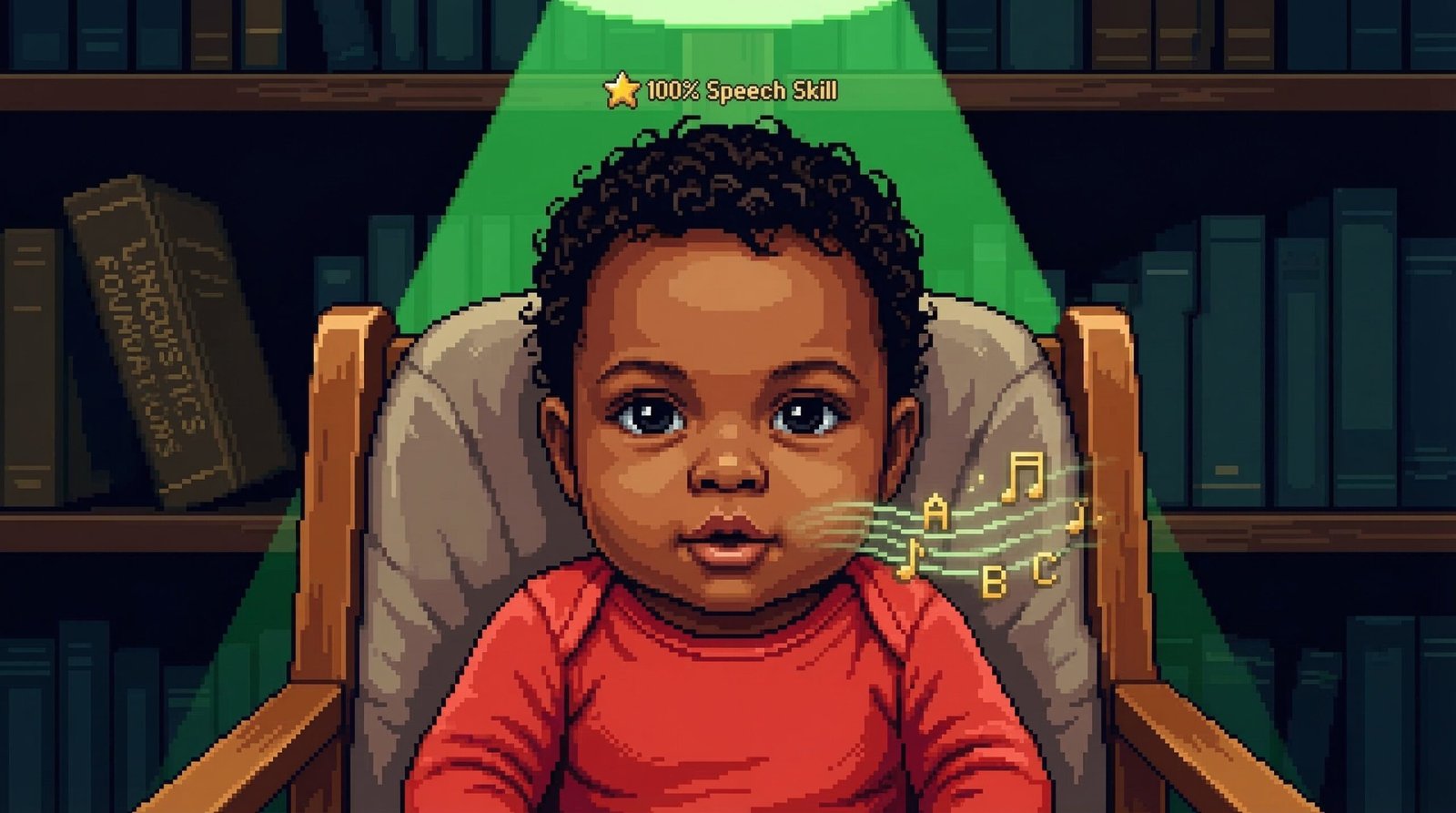
What does a baby have? Zero understanding. Can’t follow a conversation. Doesn’t know what anything means. But the production hardware is clean, uncorrupted, no fossilized habits, no accent carried over from somewhere else.
That’s what I’d be. A baby who already speaks flawlessly. Imagine saying things perfectly and people going, “Damn, that was really well said”, even if it had nothing to do with what the conversation was about. So what? Baby learns. Baby acquires. Baby spends more time in the language because the language feels good coming out of his mouth.
The perfect speaker is the baby with a cheat code.
[UNDERSTANDER]: The perfect speaker is a baby who sounds like an adult but comprehends like a toddler. You know what people do with those? They pat them on the head and talk to someone else.
[SPEAKER]: —
[UNDERSTANDER]: Also, you keep saying “baby learns, baby acquires.” How? How does the baby learn? By understanding what it hears. The baby’s superpower isn’t its mouth. It’s its ears. The mouth is just the evidence that the ears did their job.
[SPEAKER]: Okay. Okay, fine. But here’s where you lose…
[SPEAKER]: Perfect understanding sounds like a curse.
If I understand everything, every joke, every subtext, every double meaning, every lie, every implication, what’s left to discover? Where’s the surprise? I’m playing a video game with infinite currency. There are no stakes. There’s no moment of “oh wait, THAT’S what she meant”, because I already know. Always. Immediately.
The fun of language lives in the gap. The gap between what you heard and what you think it meant, that’s where discovery lives. Perfect understanding kills that. You’re sitting in a dark room knowing everything, expressing nothing, wondering why life feels so flat.
[UNDERSTANDER]: So your argument for perfect speaking is… ignorance is bliss?
[SPEAKER]: My argument is that discovery requires not knowing. And not knowing is fun.
[UNDERSTANDER]: Know what else is fun? Understanding a joke when someone tells one. Watching a movie and not needing subtitles. Hearing the argument at the next table and knowing exactly what’s going on. Following a live streamer ranting at 200 words per minute and catching every single word.
You know what isn’t fun? Everyone around you laughing and you’re standing there smiling because you don’t want to ask “what did they say” for the fourth time tonight.
[SPEAKER]: That was personal.
[UNDERSTANDER]: It was supposed to be.

And this is where the hypothetical started falling apart on me.
Because at this point I realized, I had no idea what I was actually arguing about.
What does “perfect speaking” even mean? Is it just accent? Is it vocabulary? Is it knowing what to say in every social situation? Because if it includes knowing the right thing to say at the right time, that requires understanding the context. Which requires… understanding.
And what does “perfect understanding” mean? Is it just decoding sounds? Or is it comprehension, grasping meaning, intent, culture, subtext? Because some of that starts to bleed into knowledge, wisdom, lived experience. Where does “understanding a language” end and “understanding life” begin?
I kept trying to draw a clean line between speaking and understanding, and every time I picked up the pencil, the line smeared.
So I tried redefining the hypothetical.
Attempt #2: Your speaking is maxed. Your understanding is permanently capped at wherever it is today. Can never improve. OR: Your understanding is maxed. Your speaking is permanently capped at wherever it is today. Can never improve.
But this version was broken too. If my understanding is permanently capped, as in, I can never learn to comprehend a single new thing, then perfect speaking is useless. I’d be a parrot forever. And if my speaking is permanently capped, I can never improve even slightly, then perfect understanding makes me a monk on a mountain nobody visits. Wisdom locked behind a mouth that can’t deliver it.
Both options at their extremes are prisons. That’s not a useful thought experiment. That’s just choosing which cell has better lighting.
So I tried again.
Attempt #3, the one that actually worked:
One stat is maxed. The other is NOT capped, but it stays wherever it is right now, and you have to do the work to improve it yourself. It can get better. It can get worse. It can grow. But it’s not maxed, and nobody’s helping you.
NOW we have a real question.
Because now the Speaker can say: “I’ll improve my understanding over time. I’m not locked out, I just have to grind.” And the Understander can say: “I’ll improve my speaking over time. I’m not mute, I just have to practice.”
Both sides have a path forward. Both sides have work to do. The question becomes: which starting position gives you a better foundation for the grind ahead?
And to answer that, I had to stop thinking about perfection and start thinking about debuffs.
Forget “which perfection is better.” Instead: what are the actual daily debuffs each person lives with?
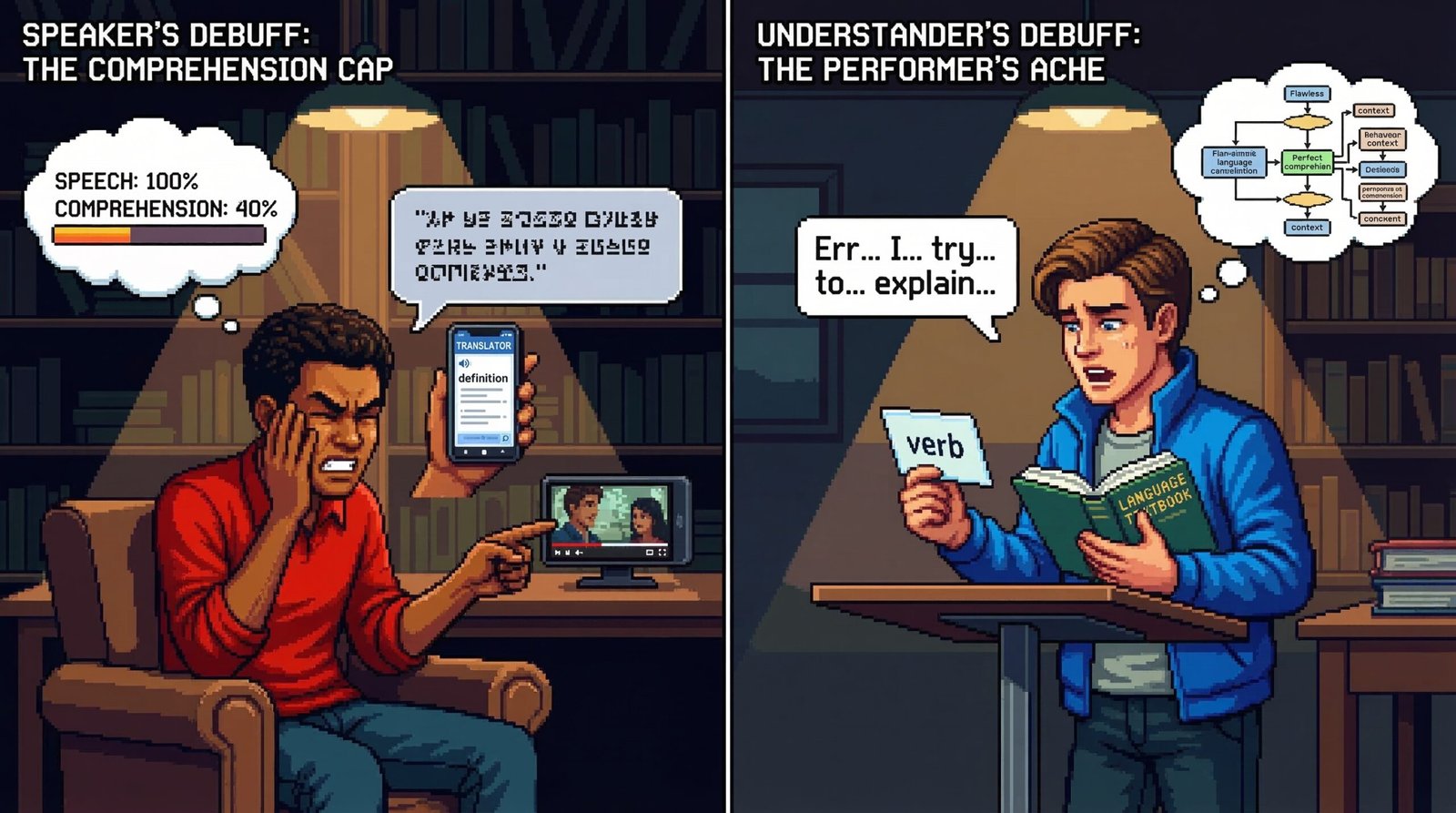
🗣️ The Speaker’s Debuffs
(Perfect speaking. Understanding stays where it is now.)
- Can’t watch a show in the language and follow the plot without subtitles or a translator
- Real-time conversations have an expiration date, you run out of comprehension before you run out of things to say
- Functionally illiterate, menus, signs, text messages, articles are all a wall
- Can give a speech but can’t have an exchange
- People speak at their natural speed and you catch maybe half on a good day
- Every relationship you build in the language has the same ceiling: the moment they realize your comprehension doesn’t match your pronunciation, something shifts
- You need people to slow down, repeat themselves, simplify, the exact things that make you feel like a tourist again
👂 The Understander’s Debuffs
(Perfect understanding. Speaking stays where it is now.)
- Your accent is obviously foreign
- The first time you say anything new, it comes out clunky
- You hesitate, search for words, take the long way around sentences
- People might switch to your native language out of convenience
- You sometimes sound like a textbook that got dropped in a blender
- That bilingual-kid ache: you understand everything but can’t perform at the level you know you should
Now read those two lists again.
One is a list of walls that block you from living in the language. The other is a list of inconveniences that shrink with practice.
The Speaker’s debuffs mean you can’t receive the world. You broadcast on every frequency and pick up nothing. You’re all signal, no reception.
The Understander’s debuffs mean you can’t perform in the world, yet. You receive everything. You process everything. You just can’t express it cleanly. Yet.
[SPEAKER]: But my debuffs shrink too! I can watch shows, listen to podcasts, grind my understanding over time,
[UNDERSTANDER]: Can you though? Talking more doesn’t teach you to understand what people say in response. Output doesn’t generate input. You can’t decode the world by producing more sound into it.
Meanwhile, every conversation I have, even the awkward, stumbling, accent-heavy ones, is speaking practice. My debuffs shrink automatically because the act of living in the language IS the exercise. The muscle gets worked every single day. Your debuffs require a completely separate training regimen that has nothing to do with your maxed-out skill.
[SPEAKER]: …
[UNDERSTANDER]: Your perfect accent doesn’t help you understand the train announcement. My imperfect accent doesn’t stop me from understanding every word of it. Who’s actually navigating the country right now?
I need to be honest about something.
I kept trying to argue both sides fairly. I really did. But somewhere around the debuff framework, I realized I wasn’t arguing a hypothetical anymore. I was describing something I’d actually lived.
When I first started learning Korean, I memorized a scripted line and walked up to a Korean classmate in high school. Delivered it. Probably sounded decent. She responded naturally, and I could not understand a single word that left her mouth.
“What did you say?”
She repeated herself. Tried something simpler. Still nothing.
That was not in my script.
That was my first encounter with the illusion of speaking without understanding. I could produce the sounds. I could not process the response. The “conversation” lasted exactly one scripted line and ended the moment the other person opened their mouth.
I was the Speaker. With all his debuffs. Standing there smiling, waiting for a response I couldn’t decode.
Here’s what I actually did instead.
I spent 18 months immersing in Korean before I did any serious speaking. Shows, podcasts, live streamers, music, everything in my life that could be Korean was Korean. I used tools like Migaku and spaced repetition to learn 10 new words a day. I didn’t study dialects. I didn’t do pronunciation drills. I just lived in the sound of the language until the sound became meaning.
By the time I went to Korea, my speaking was rough. Obviously. The muscle hadn’t been used. The first time I opened my mouth in a real conversation, it was bad. Everything I said, I was saying out loud for the very first time.
But here’s what was different from that high school moment:
When the other person responded, I understood them.
I could follow. I could navigate. When I fumbled a sentence and someone corrected me, I caught it, because comprehension wasn’t the bottleneck. Production was. And production is a muscle.
Within two months of conversations every single day, sometimes ten a day, texting, calling, stumbling through everything, I found my voice. Not just functional speech. My personality in the language. Humor. Sarcasm. Warmth. The ability to be myself in Korean.
And every single bit of it was rooted in the thousands of hours I’d spent understanding the language before I ever tried to produce it.
The first attempt was the worst I ever sounded. Every day after that was better. Because when you understand deeply, every attempt to speak is informed by an intuitive sense of how the language actually sounds when real people use it. You’re not guessing. You’re reaching for something you’ve heard a thousand times and just haven’t said out loud yet.
Now, I want to be careful. Because the point isn’t “speaking first is wrong.” People who speak from day one can build impressive skills. The desire to speak is the whole reason most people learn a language in the first place. I’m not here to tell anyone their approach is trash.
But here’s what I’ve seen, again and again, in learners who skip the understanding phase:
Fossilized mistakes. Accents that calcify because the speaker never built an internal model of what the language actually sounds like at native speed, in native contexts. They built their model from their own output, which was based on a textbook, which was based on approximation.
Your subconscious maps out a model of the language based on what it’s exposed to most. If what it’s exposed to most is your own imperfect production rather than thousands of hours of native input… that model sets like concrete.
People live with accents their entire lives. Not because accents are impossible to change, but because the foundation underneath was poured wrong. And rebuilding a foundation is a different project entirely from building on the right one from the start.
This isn’t a judgment. It’s a trade-off. And I think every learner deserves to see the trade-off clearly before they choose their path.
[SPEAKER]: Fine.
[UNDERSTANDER]: Fine what?
[SPEAKER]: Fine, you make a decent point. Understanding is the soil. Speaking is the tree. You can’t grow a tree without soil. I get it.
But can I say something?
[UNDERSTANDER]: Go ahead.
[SPEAKER]: Nobody wants to be the soil. Everyone wants to be the tree. The tree is what people see. The tree is what people compliment. Nobody walks past a garden and says “wow, incredible soil.” They say “wow, beautiful tree.”
The desire to speak, to express, to connect, to be heard in a language that isn’t yours, that’s not shallow. That’s the whole point. Understanding without the courage to eventually open your mouth and sound terrible is its own kind of prison. A comfortable one. But still a prison.
[UNDERSTANDER]: I know.
And for the record, I never said understanding was the destination. I said it was the starting point. You still have to speak. You still have to be bad at it. You still have to live through every awkward first attempt at every sentence you’ve never said out loud.
But when you do, when you finally open your mouth after all that time listening, you’re not guessing. You’re not performing. You’re reaching for something real. And every time you reach, you get a little closer.
One of these “prisons” has a door that opens with practice. The understander who can’t speak well improves by speaking. Every day, the debuffs shrink. Every interaction, the muscle gets stronger. The foundation holds.
The speaker who can’t understand? That door doesn’t open from the inside.
So here’s where I landed after weeks of arguing with myself.
I tried three different versions of this hypothetical. The first one was too vague. The second one was too extreme. The third one finally worked, and the moment it worked, it stopped being a hypothetical and started being a description of how language learning actually functions.
You can’t cleanly separate speaking from understanding. I tried. Believe me, I tried. Every argument for speaking eventually collapsed back into “but you’d need understanding to make that work.” The terms wouldn’t stay in their boxes. The line kept smearing.
And maybe that’s the whole point.
They aren’t two skills to be ranked. One is the soil. One is the tree. And if you’re wondering which to invest in first, look down, not up.
Connection isn’t built from the words you use. It’s built from the way you listen.
So. Do we agree? Understanding?
[SPEAKER]: …
[UNDERSTANDER]: …
[SPEAKER]: I mean… yeah. But bro, perfect speaking was literally on the menu. Like, the genie was right there. You’re telling me you’d look a genie in the face offering you a flawless Busan accent and say “nah, give me comprehension”?
[UNDERSTANDER]: Every time.
[SPEAKER]: You’re insane.
[UNDERSTANDER]: And you’d understand why if you could understand anything.
[SPEAKER]: …Okay that was good. I hate you. But that was good.


Struggle Less. Acquire More. Enjoy Life.
Studied at Yonsei University. Worked in Korean politics. Reached fluency in 18 months through pure immersion.
Now I help language learners cut through the noise and achieve what most think is impossible.
Gain A New Perspective On Language & Life
I went from understanding 0% of Korean dramas to discussing politics at Yonsei in 25 months—using the same immersion principles I teach every Saturday.