Not A Subscriber?
Join 917+ language learners getting mindf*cked every Saturday morning while getting Immersed.
Most Language Learners Never Cross This Line
March 22th, 2026 | Ademola Adeyemi
There’s a threshold in language learning that changes everything.
As corny as this may sound, I’ve always wanted to sound like I belonged.
Not just passable. Not just “good for a foreigner.” I wanted to speak Korean, to truly hear and produce the language, at a level where native speakers would treat me like one of them. Where the rhythm felt natural. Where I could think, joke, and express complex ideas without that mental translation lag.
I wanted to be multidimensionally fluent. Not just comprehension, not just speaking ability, but the whole package: accent, competence, confidence.
This desire has drastically influenced the past five years of my life.
As someone who immersed in Korean, first from Maryland/DC without ever living in Korea, then later in-country, I became obsessed with pattern recognition. Why do some learners reach native-like proficiency while others plateau after years of classes? Why does the school language student with 1,000 speaking attempts sound worse than the immersion learner with 100?
After five years of acquisition, personal experimentation, and validation against SLA research from Krashen, Swain, and Selinker, I’ve noticed one critical pattern that separates learners who make it from learners who don’t.
There’s a line. And most learners never cross it.
The Immersion Line
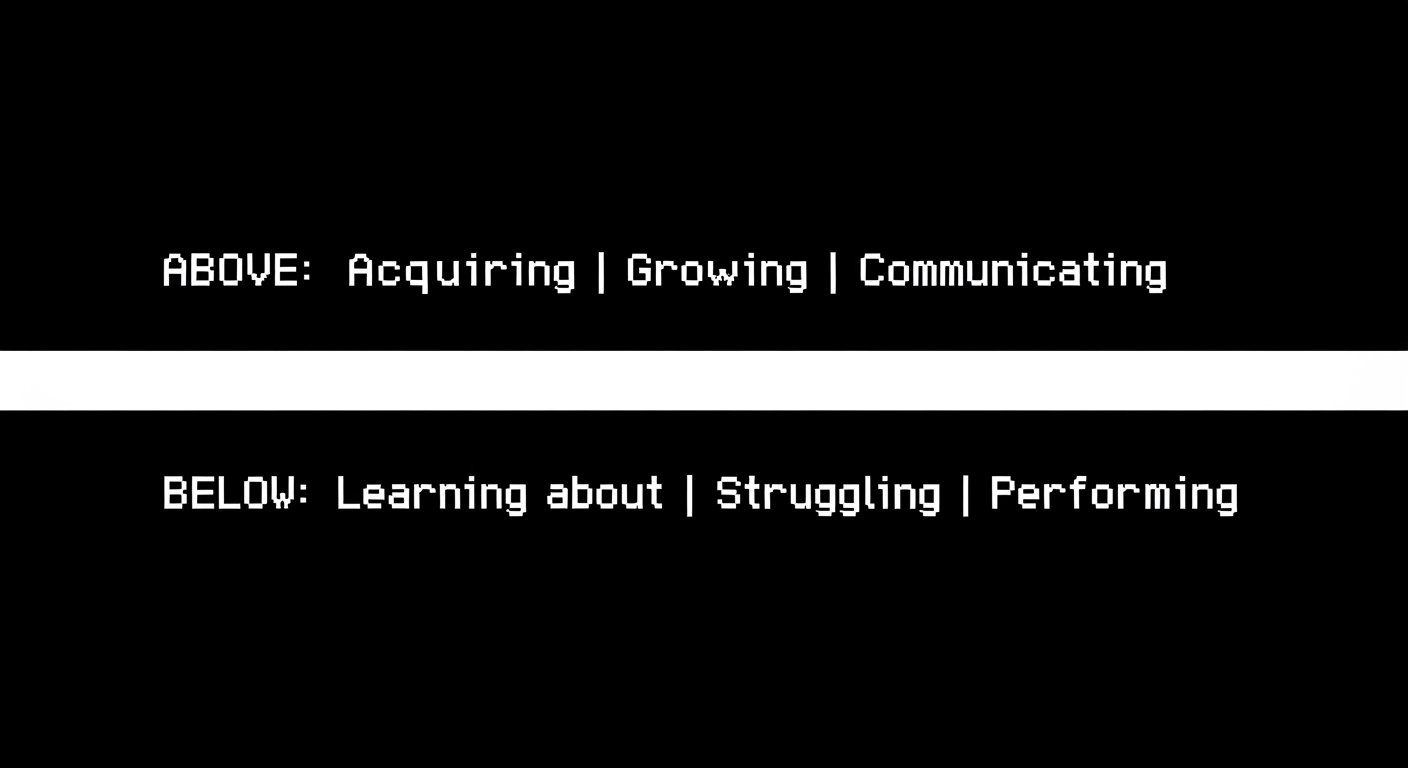
Below the line: You’re learning about the language. Watching K-dramas with English subtitles. Gathering phrases. Using translators to perform conversations. You know about Korean, but you’re not acquiring Korean.
Above the line: You’re acquiring the language. Consuming content in the target language. Building comprehension through immersion. Understanding precedes output.
This is the single most important threshold in language acquisition. Cross it, and everything accelerates. Stay below it, and you can study for years without real progress.
What Determines Which Side You’re On
It’s not about hours studied. It’s about the tools you use.
Here’s how to diagnose yourself:
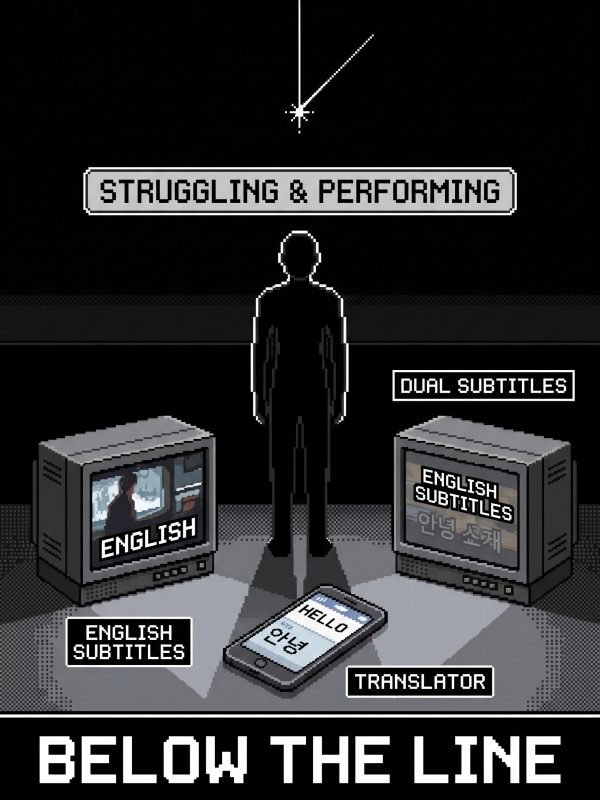
Below the Immersion Line:
Tool | Native Equivalent | Why It Keeps You Below |
English subtitles | 0% Native | Eyes locked on bottom of screen. Learning about the show, not acquiring Korean. |
Dual subtitles | 10% Native | Better, but same problem. Your brain defaults to English. |
Translator | 0% Native | Obscures grammar, hides patterns, creates false associations. Can’t account for formality, register, or context. |
Crossing the Immersion Line:
Tool | Native Equivalent | Why It Moves You Up |
Target language subtitles | 100% Native | Natives use their own subtitles. You’re performing a native activity. |
Bilingual dictionary | 50% Native | Word-by-word parsing without full translation. The threshold tool. |
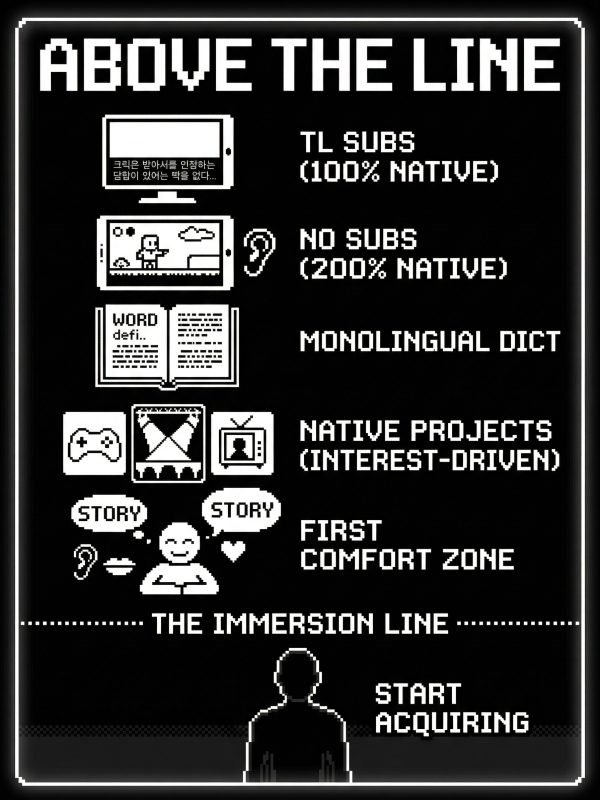
Above the Immersion Line:
Tool | Native Equivalent | Why It Accelerates You |
No subtitles | 200% Native | Natives don’t watch with subtitles. Training your ear for real conversation. |
Monolingual dictionary | 100% Native | Reinforces target language associations. Thinking in the language. |
The graduation sequence:
- Translator → Bilingual dictionary
- English subtitles → Target language subtitles
- Target language subtitles → No subtitles
- Bilingual dictionary → Monolingual dictionary
Each graduation moves you further above the line.
Why Most Learners Never Cross
The Immersion Line reveals a brutal truth about language learning:
HIGH Understanding + LOW Conversation Attempts = POOR OUTPUT
LOW Understanding + HIGH Conversation Attempts = POOR OUTPUT
This is the Poor Output Equation. Both imbalances create the same frustration.
The School Language Student lives below the line with the second imbalance: high conversation attempts (forced speaking practice), low understanding growth (no immersive input). Years of classes. Can’t hold a real conversation.
The Frustrated Immersion Learner sometimes crosses the line but falls back: 500 hours of K-dramas with English subtitles. Lots of exposure. Zero acquisition. Why? English subtitles keep them below the line—they’re learning about the show, not acquiring the language.
Both get told to “just keep going.” Neither gets diagnosed.
The diagnosis matters more than the prescription.
The Highest ROI Activity (Before You Cross)
Before you can cross the Immersion Line, you need a foundation.
The highest ROI activity in language acquisition: Learn the 1,000 most frequently used words.
Why? These words appear in 80-90% of all speech. Learning them takes your comprehension from 0% → 60-80%.
That’s the threshold where immersion becomes possible. Below that, native content is noise. Above that, native content becomes comprehensible.
The Foundation Stack:
- SRS habit — One habit from day one to fluency. Not about remembering—about not forgetting. Daily reviews, non-negotiable.
- 1,000 word foundation — Highest frequency words first. Graded content is acceptable during this phase.
- Sentence mining introduction — 10 new words per day. Each sentence has one unknown word (i+1 principle). Sentences from native content, native audio.
Once you hit the 1,000 word threshold, native content becomes your primary source.
Then you cross the line.
What Happens When You Cross
Above the Immersion Line, your goal becomes reaching your first comfort zone—the most critical milestone in language acquisition.
A comfort zone is reached when:
- Understanding flows without stress
- Content can be enjoyed without constant lookup
- New elements are acquired without deliberate study
- Comprehension occurs without subtitles
Critical clarification: A comfort zone is NOT about understanding everything. It’s NOT about perfect comprehension. It’s NOT about finishing a curriculum.
It’s about understanding enough that the story drives your time, not your struggle.
When you’re watching a drama and you forget you’re learning—when you’re just enjoying—that’s your first comfort zone.
This is when everything changes:
- You can now hear the difference between native speech and your own
- Self-correction becomes possible
- Output practice becomes safe (speaking won’t solidify bad habits)
- Acquisition accelerates exponentially
Before your first comfort zone, high-volume speaking is risky—you fossilize errors you can’t hear. After your first comfort zone, speaking becomes safe—your trained ear catches mistakes.
Above the Immersion Line, your goal becomes reaching your first comfort zone—the most critical milestone in language acquisition.
A comfort zone is reached when:
- Understanding flows without stress
- Content can be enjoyed without constant lookup
- New elements are acquired without deliberate study
- Comprehension occurs without subtitles
Critical clarification: A comfort zone is NOT about understanding everything. It’s NOT about perfect comprehension. It’s NOT about finishing a curriculum.
It’s about understanding enough that the story drives your time, not your struggle.
When you’re watching a drama and you forget you’re learning—when you’re just enjoying—that’s your first comfort zone.
This is when everything changes:
- You can now hear the difference between native speech and your own
- Self-correction becomes possible
- Output practice becomes safe (speaking won’t solidify bad habits)
- Acquisition accelerates exponentially
Before your first comfort zone, high-volume speaking is risky—you fossilize errors you can’t hear. After your first comfort zone, speaking becomes safe—your trained ear catches mistakes.
Immersion Projects vs. Learning Projects
Here’s a framework that will save you from spinning your wheels:
Below the Immersion Line = Learning Projects
- Controlled comprehensibility
- Structured progression
- Comfortable pace
- Clear milestones
- Weakness: Limited to available graded content (you can’t find graded content about Apex Legends or your specific interests)
Above the Immersion Line = Immersion Projects
- Interest-driven content selection
- “For natives, by natives” material
- Tailored to domains you actually care about
- No ceiling on depth
The key insight: An immersion project is NOT a cage. You can watch other content. But the project is where you study—other content is enjoyment.
When you designate a domain as your immersion project (web dramas, gaming streams, K-pop variety shows), that’s your deliberate practice zone. You mine sentences from it. You look up words. You replay sections.
Everything else? Just enjoy.
The Interest ÷ Speaking Need Equation
How do you choose your immersion project?
Two factors:
- Your interests — What content do you actually want to consume?
- Your speaking timeline — How soon do you need to speak?
Here’s the equation:
If your need to speak = ASAP: Your immersion project should be narrow. It should mirror the environments and people you’ll actually speak with. If you need to survive in a café, a relationship, a job. Immerse in content that covers those domains specifically.
If your need to speak = no timeline: Interest-driven becomes infinite. You can explore whatever you want. No deadline means no constraint on domain selection.
The formula: Interest-driven / Need to speak
If need to speak = 0, interest drive = infinite. If need to speak = high, interest drive gets constrained by practicality.
I went broad because I had no speaking timeline. I knew how critical accent development was, so I prioritized deep input before any output. That gave me freedom to follow my interests wherever they went.
Environment > Location
Here’s the truth that will save you years of waiting:
Living in the target country ≠ automatic acquisition.
I spent my first two years learning Korean in Maryland/DC. I never need to set foot in Korea by building a deliberate immersive environment:
- Phone set to Korean
- Media consumption entirely in Korean
- Social media algorithm switched to Korean content
- Reading materials in Korean
- Music, podcasts, notifications all in Korean
When I eventually moved to Korea, I encountered expats who had lived there for 5+ years without learning Korean. Why? Their immediate environment remained in English.
Physical location provides opportunities. Deliberate environment provides acquisition.
You can cross the Immersion Line from anywhere. You just have to build the environment deliberately.
The Ratio Principle
One final truth:
Speaking is not the enemy. Lack of input makes speaking the enemy.
The damage isn’t in output. It’s in the ratio.
If you speak more than you input, you fossilize errors. You perform language rather than communicate. You solidify patterns you can’t hear are wrong.
Everyone needs to be listening or consuming MORE than they are speaking. No native speaker speaks more than they listen or comprehend. That’s the fact of language in life.
The safe output ratio: 80% input, 20% output (before first comfort zone)
After your first comfort zone, the ratio can shift. Your ear is trained. Self-correction is possible. Speaking becomes safe and a whole lot more fun.
Your Next Action
Diagnose yourself:
Are you below the Immersion Line?
- Still using English subtitles?
- Relying on translators?
- Learning about the language more than acquiring it?
→ Your action: Graduate your tools. Switch to target language subtitles. Replace translator with bilingual dictionary. Build your 1,000 word foundation if you haven’t.
Are you crossing the Immersion Line?
- Using target language subtitles?
- Building an immersive environment?
- Prioritizing input over output?
→ Your action: Push toward your first comfort zone. Find a domain (cheesy drama, gaming streams, variety shows) and immerse until the story drives your time, not your struggle.
Are you above the Immersion Line?
- First comfort zone achieved?
- Can you consume without subtitles in at least one domain?
→ Your action: Expand your N. Each new comfort zone accelerates the next. Build domain range.
This is the foundation of The Immersion Map.
My mission is to answer one question: how do you actually acquire a language? Not study it. Not perform it. Acquire it. From anywhere. Without moving. Without classes that lead you to debt.
Cross the line, build the environment, reach your first comfort zone.
Everything else follows.
The language you’ve always wanted to speak fluently is waiting on the other side of your first breakthrough.
Till next time. Happy immersing,
– Ade Immersed

Struggle Less. Acquire More. Enjoy Life.
Studied at Yonsei University. Worked in Korean politics. Reached fluency in 18 months through pure immersion.
Now I help language learners cut through the noise and achieve what most think is impossible.
Gain A New Perspective On Language & Life
I went from understanding 0% of Korean dramas to discussing politics at Yonsei in 25 months—using the same immersion principles I teach every Saturday.