Not A Subscriber?
Join 752+ language learners getting mindf*cked every Saturday morning while getting Immersed.
How To Learn A Language Without Destroying Your Life
December 27th, 2025 | Ademola Adeyemi
Win before the world gets up.

The 8 PM Graveyard
Most people lose their days before their days even begin.
They wake up at 8:00 AM. Scroll their phone. Check social media. Respond to texts. Eat breakfast while watching YouTube. Shower while thinking about everything they have to do today.
By 9:00, they haven’t done anything productive. But they feel busy. They feel like the day is already happening to them. Like they’re reacting to the world instead of creating their own.
Then life really starts.
Class at 10.
Meeting at 11.
Friend needs help at 1.
Assignment due at 3.
And somewhere around 8:00 PM, exhausted and depleted, they think: “I should do my Korean now.”
They’ve already lost. They just don’t know it yet.
Because by 8:00 PM, you have nothing left.
Your willpower is gone.
Your brain is fried.
Your body is tired.
And the people around you, the algorithms, the friends, the obligations, they’ve already eaten your entire day.
You fall behind.
You tell yourself: “I’ll do it tomorrow morning.”
But tomorrow morning looks exactly the same.
The cycle repeats. You feel guilty. You quit.
This is the default path.
The 10 AM Victory
Now imagine a different timeline:
6:00 AM. Alarm goes off. The world is silent. Your phone hasn’t buzzed.
This is your window.
This is the victory lap you run before the race even starts.
You sit down at your desk. In your space. In the quiet.
6:00-6:30: SRS reviews. Just you and your flashcards.
6:30-7:30: Sentence mining. You’re watching Korean, making cards, actively learning.
7:30-9:30: Active immersion. Two hours of watching Korean content, subtitles off, just you and the story.
9:30-10:00: Output practice. Journaling in Korean, or texting a language partner.
Your brain is still fresh. Your willpower is still full.
And then you look at the clock.

It’s 10:00 AM.
The Sacred Six Hours
I structured my entire university schedule around this principle.
When I was registering for classes each semester, I made sure nothing started before noon. My academic advisor thought I was crazy. “You’re going to end up with terrible time slots,” she said.
But I knew what I was doing.
Those morning hours: 6 to 12 were sacred.
Six hours.
I only needed 4 for my immersion, which left 2 hours for:
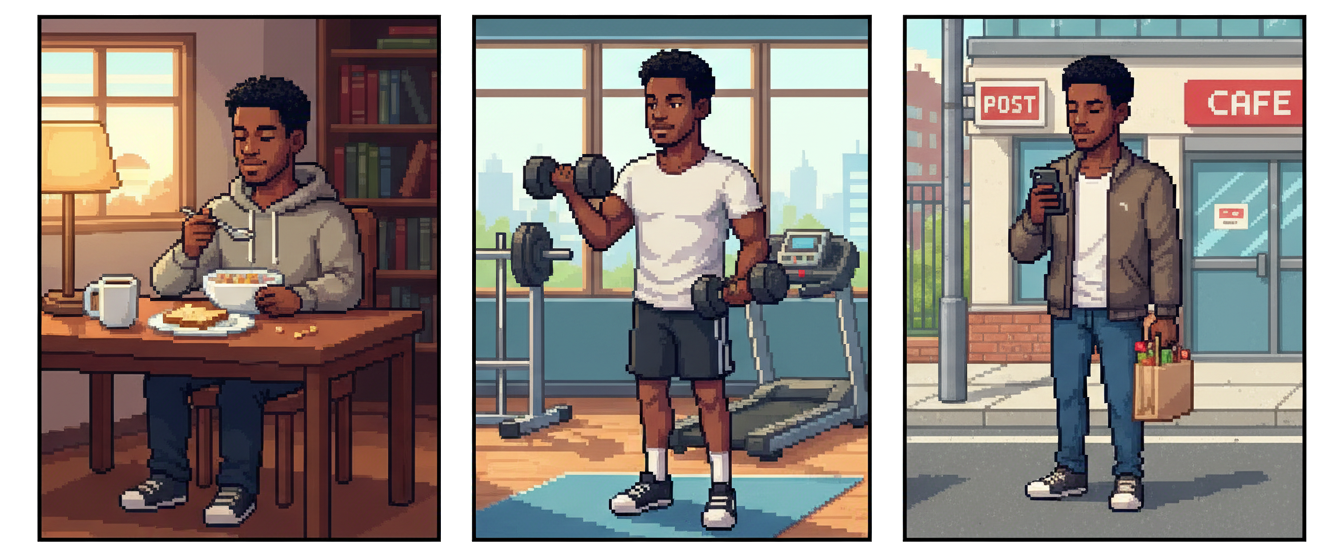
- Breakfast
- Going to the gym
- Little life errands
And when my friends would text at 2 PM asking to hang out, I could evaluate honestly:
“Do I actually want to go?”
Not “Can I afford to lose the study time?”
Because my work was complete.
You’ve done your hours. Most learners don’t do four hours in a week. You did it before most people ate breakfast.
This is the 10:00 AM victory.
“But I Don’t Have 4 Hours”
But wait:
“I don’t have 4 hours. My life doesn’t look like that. What am I supposed to do?”
Fair. Your life looks different.
Here’s what you need to understand: 4 hours and up at 6 AM isn’t the cure.
It’s the result.
The cure is the audit. The reflection. The decision to structure your life around your goals instead of hoping your goals will one day fit into your life.
The principle that changed my life: Do your work before the world catches up to you.
Here’s how you figure out what that looks like for YOUR life:
Finding Your 4 Hours
It starts with taking radical ownership of your schedule.
Step 1) Audit Your Days
This is the most important step.
For one week, track what you actually do every hour. Write it down. Be brutally honest.
Don’t write what you wish you did or what you think you should have done. Write what you actually did.
You’ll see where your 24 hours are going every single day.
- Work Time
- Family Time
- Commute Time
- Screen TIme (Watch and Listening Time)
This will show you exactly where your time is going.
Ask yourself:
- Do my daily actions mirror the life I desire?
- Do they move me in the direction of my goals?
You can’t fix what you don’t measure.
Step 2) Identify What You’re Willing To Sacrifice (And What You’re Not)
Be honest about your values.
- What relationships matter to you?
- What responsibilities can’t you abandon?
- What parts of your life are non-negotiable?
For me: Family was non-negotiable. Being a good son mattered. My relationships mattered.
What I was willing to cut:
- Keeping up with the trends
- Mindless scrolling (in English)
- Games I couldn’t enjoy with my bros (especially English)
- Time wasters that aligned with nothing I valued (aka no Korean touch point identified)
Once you know what you’re keeping and what you’re cutting, you can build a schedule around your real priorities.
Step 3) Set An Alarm For Bedtime, Not Wake-Up
This one’s from Alex Hormozi, and it changed everything for me.
Most people set alarms to wake up at 6 AM, then go to bed at midnight and wonder why they can’t stick to it. That’s backwards.
Flip it.
Set an alarm for 10 PM (or whatever time gives you 7-8 hours for your target wake-up). When it goes off, you go to bed.
You can’t win your mornings if you’re losing your nights.
Step 4) Do Your Language Work Immediately
This is the core principle I built my immersion around: Do the work before the world catches up to you.
For me, that looked like starting at 6 AM and finishing by 10 AM. Four hours of structured immersion (SRS, sentence mining, active listening). The specifics of how I structured those hours week by week, how I overcame plateaus, how I built my environment… that’s the system I’ll be sharing with you soon.
If your schedule looks different, cool beans.
The principle is what matters: Figure out when “early” is for YOUR life, then protect that time fiercely.
Step 5) Accept That The First 2-3 Weeks Will Be Hard
If you’ve been living one way for years, changing your schedule means changing your life.
Your body will resist. Your brain will negotiate. You’ll want to go back to the old way.
That’s normal.
Push through. By week three, the new rhythm starts to feel normal. The habits start to form. The resentment starts to fade.
If you want different results, you can’t live the same life.
If you desire to be somewhere else, you have to change the actions you do every single day.
And changing those actions requires more effort upfront.
But that effort builds the habits that make everything easier later.
Most people stay stuck because they’re waiting for it to get easier before they start.
But it doesn’t work that way.
You have to make it hard first, so it can be easy later.
The Senate Test

“How’d you manage when life started happening before 12? Bet it was much harder…”
Well yeah, but not really. Just did the audit all over again.
When I worked at the Senate, my mornings looked like this:
5:00 AM – Wake up. 30 minutes of SRS
Reviewed my SRS cards in Migaku Memory + 10 sentences I mined the day before. Then suit and tie. Out the door at 6:30.
6:30 AM – 45 minute drive. Passive Listening
My favorite Korean podcasts: 수다일리스트 or KBS 무대. Couldn’t mine sentences while driving, but I could absorb.
7:15 AM – 1.5 hr Metro ride to Union Station
Migaku app open. Sentence mining. Reading Korean books. Consuming content.
I’ll note that by this stage, I’d reached critical mass.
I wasn’t “studying Korean” anymore.
I was learning about politics, world events, and culture… through Korean.
Which meant when I got to work at 9 AM, I had real things to talk about beyond “I’m learning Korean.”
After work, same thing in reverse.
Podcasts on the Metro. Audio review in the car.
By the time I got home at around 7:30 PM, I was tired af.
But I didn’t need to “language learn” anymore.
I just lived.
My phone was in Korean.
My environment was built so scrolling, watching TV, and chilling out = Korean Immersion (but for me it feels like just listening to and watching stuff I was interested in).
The system works whether you’re a student or a working professional. You just audit your life and find your 4 hours you have before the world catches up to you.
Same principle. Different execution.
Win Before Breakfast
Most people lose by default because they never changed the rules.
You don’t have to live that way.
The morning conquest isn’t about waking up at 5 AM because some productivity guru said so.
It’s about winning your day before the world wakes up.
It’s about protecting your life goals, whatever that looks like for YOU, before life starts asking for your time.
When you do that, everything changes.
You’ve already won.
And the rest of your day? That’s yours.
Your move:
If you’re serious about this, start tomorrow.
Set the alarm for bedtime tonight. Audit your day this week. Identify where your 4 hours are hiding.
Then take them back.
Conquer your morning. Protect your peace. Build the life you actually want.
Everything else is negotiable.
ㅡ Ade
Quick thing:
If you’re interested in the tools I use:
Migaku covers most of the technical sides of things – use my link for 10% off Lifetime or +1 free month (try it out 10 days free): migaku.com/adeimmersed
As we close out 2025 and wrap up the week, hope this one hit.
If you’re new here and this resonated, I’ve written about a few related ideas worth checking out:
- 10 Language Learning Secrets from Someone Who Actually Did It – the core principles I used to go from zero Korean to thinking and dreaming in it
- Why Your Brain Gave Korean A Storage Closet – the neurological reason you feel stuck (how to solve it)
- How To Learn Any Language Like You’re Already Native – how to stop “studying” Korean and start living it by finding your target language doppelgänger
- Why You Feel Fluent On Monday And Fraudulent By Friday – why the days you feel like an imposter are proof you’re progressing faster than beginners who feel “fine”

Struggle Less. Acquire More. Enjoy Life.
Studied at Yonsei University. Worked in Korean politics. Reached fluency in 18 months through pure immersion.
Now I help language learners cut through the noise and achieve what most think is impossible.
Gain A New Perspective On Language & Life
I went from understanding 0% of Korean dramas to discussing politics at Yonsei in 25 months—using the same immersion principles I teach every Saturday.